


Pet Relocation from Dubai: The Complete Guide to Moving Your Pet Internationally
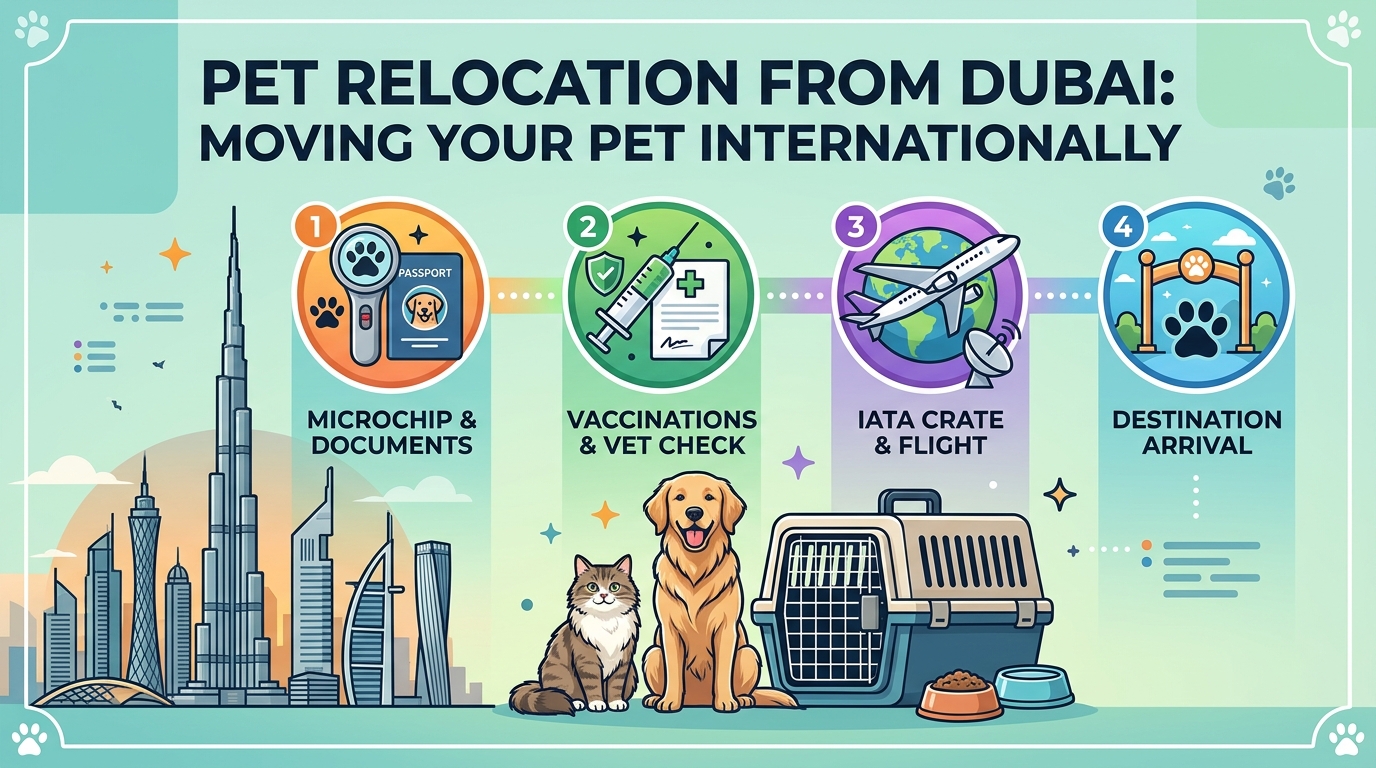
Moving to another country can be complicated, particularly when you have pets.
For many Dubai residents, dogs and cats are important members of the family. Whether you are returning to your home country, accepting an overseas job or moving to another destination, taking your pet with you requires careful planning.
Pet relocation involves more than booking an airline ticket. Owners must consider veterinary examinations, vaccinations, microchipping, export documentation, airline regulations, travel crates and the destination country’s import requirements.
Fortunately, Dubai has several specialist pet relocation companies that can help coordinate the process.
This guide explains how to relocate your pet from Dubai, what documents you need and how to prepare for a safe journey.
1. Start Planning Your Pet’s Relocation Early
The first step is to research the pet import regulations of your destination country.
Different countries have different requirements for animals entering their territory.
Depending on the destination, your pet may require:
- A permanent identification microchip.
- Valid rabies vaccination.
- Other mandatory vaccinations.
- Rabies antibody titre testing.
- Veterinary health examinations.
- Import permits.
- Official health certificates.
- Parasite treatments.
- A quarantine period.
Some countries require additional laboratory tests or specific waiting periods after vaccination.
Start researching several months before your planned departure, particularly if your destination requires rabies titre testing or a mandatory waiting period.
2. Check Your Pet’s Microchip and Vaccination Records
Microchipping is an important part of international pet relocation.
The microchip provides a permanent identification number that can be used to match your pet with its vaccination records and official travel documents.
Before travelling, check that:
- Your pet has an internationally compatible microchip.
- The microchip number is recorded correctly.
- Vaccination records contain the correct identification details.
- Rabies vaccination is valid.
- Other destination-specific vaccinations are completed.
If your pet has an existing vaccination passport, check it carefully for missing information.
Ask your veterinarian to review the documents before beginning the export process.
3. Understand UAE Pet Export Requirements
Pet owners relocating from Dubai must follow the UAE’s animal health and export procedures.
The Ministry of Climate Change and Environment (MOCCAE) provides a veterinary health certificate service for exporting or re-exporting live animals.
The official process includes:
- Submitting an electronic application.
- Paying the applicable service fee.
- Arranging a physical veterinary examination.
- Completing laboratory tests if required.
- Receiving the electronic veterinary health certificate.
The MOCCAE export health certificate is currently listed as valid for 30 days from the date of issue.
The published fee for a personal consignment of up to two companion animals is AED 100. Other consignments have a different fee structure.
You should also check whether your destination country requires an import permit or additional documents before applying.
Official government information: https://www.moccae.gov.ae/
4. Understand the Destination Country’s Import Regulations
This is one of the most important stages of pet relocation.
The UAE export certificate does not automatically guarantee that your pet will be permitted to enter another country.
For example, some destinations may require:
- An import permit issued before departure.
- A rabies antibody titre test.
- Specific vaccination waiting periods.
- Treatment against parasites.
- An officially endorsed veterinary health certificate.
- Advance notification to border authorities.
- Quarantine on arrival.
The requirements for the United Kingdom, European Union, United States, Australia and other destinations can differ considerably.
Always obtain the latest requirements directly from the destination country’s official government veterinary or animal import authority.
5. Choose the Right Airline and Travel Arrangement
Pets can travel internationally under different airline arrangements, depending on the airline, destination, animal and size.
Common options include:
In-cabin travel: Some airlines allow eligible small pets to travel in the passenger cabin, subject to specific conditions and approvals.
Checked or accompanied baggage: Some airlines accept eligible animals in a designated aircraft hold under their pet travel procedures.
Manifested cargo: Animals travel as an independently documented air cargo shipment, handled through the airline’s cargo operation.
Not every airline offers all three options. Some airlines only accept pets through cargo services on particular routes.
Before booking, confirm:
- Whether the airline accepts your pet’s breed.
- Maximum crate and animal dimensions.
- Weight restrictions.
- Seasonal temperature restrictions.
- Transit and connecting flight arrangements.
- Required documentation.
- Cargo acceptance and collection procedures.
Do not assume that a pet can travel on the same flight as its owner.
6. Select an IATA-Compliant Travel Crate
Choosing the correct travel crate is essential.
Airlines generally require animal transport containers to comply with applicable International Air Transport Association (IATA) Live Animals Regulations and their own acceptance policies.
A suitable travel crate should:
- Provide enough room for your pet to stand naturally.
- Allow your pet to turn around comfortably.
- Allow your pet to lie down in a natural position.
- Have adequate ventilation.
- Have secure closures.
- Be appropriate for the animal’s size and weight.
- Include suitable absorbent bedding.
Your pet should become familiar with the crate before departure.
Introduce it gradually at home, using positive reinforcement and short practice sessions.
This helps reduce stress during the actual journey.
7. Prepare Your Pet for the Journey
International travel can be stressful for animals, particularly if they are not accustomed to crates or long journeys.
A few weeks before departure, start preparing your pet.
Useful preparations include:
- Introducing the travel crate gradually.
- Maintaining normal feeding routines.
- Keeping vaccination records organised.
- Scheduling a veterinary health examination.
- Confirming any medication requirements with your veterinarian.
- Avoiding major changes to your pet’s routine immediately before travel.
Do not sedate your pet for air travel unless specifically advised and approved by your veterinarian and the airline. Sedation can create additional risks during transportation.
8. How Much Does Pet Relocation from Dubai Cost?
The cost of international pet relocation varies significantly.
There is no universal price because several factors influence the final amount.
| Cost component | What affects the price |
|---|---|
| Veterinary examination | Clinic and medical requirements |
| Vaccinations | Vaccines required for the destination |
| Laboratory tests | Rabies titre and other tests |
| Export documentation | Government certificate and approvals |
| Travel crate | Size, material and specifications |
| Airline freight | Route, crate dimensions and chargeable weight |
| Relocation company | Services and level of assistance |
| Import fees | Destination country requirements |
A relocation involving a small cat travelling to a nearby destination may cost considerably less than transporting a large dog internationally.
A published UAE relocation guide reports that pet moves can exceed AED 4,000, although complex international routes can cost considerably more.
Always request an itemised quotation rather than relying on a general estimate.
9. Should You Use a Professional Pet Relocation Company?
Many pet owners choose to work with specialist relocation companies because international pet transport involves several organisations and administrative procedures.
A professional relocation provider may help with:
- Route planning.
- Destination-country requirements.
- Veterinary documentation.
- Government permits and certificates.
- Airline arrangements.
- Travel crate selection.
- Airport handling.
- Cargo coordination.
- Arrival arrangements.
Some companies offer complete door-to-door relocation, while others provide selected services.
Before choosing a provider, ask for a written quotation that explains what is included and which charges are paid separately to airlines, authorities and veterinary providers.
10. Pet Relocation Companies in Dubai
Dubai has several companies specialising in international pet transport.
Here are some providers worth considering.
Sandy Paws LLC
A Dubai-based pet relocation company operating from Dubai International Airport’s Cargo Village.
Its services include pet export assistance, import coordination, document preparation and airport handling.
JetSet Pets
JetSet Pets specialises in international pet relocation and travel arrangements for dogs and cats.
The company helps coordinate documentation, travel planning and the logistics involved in moving pets internationally.
Carry My Pet
Carry My Pet provides international pet relocation services to and from the UAE.
Its airport-based operation focuses on export documentation, import procedures and coordination of animal transportation.
Pawsome Pets UAE
Pawsome Pets UAE offers international pet relocation services and also operates a pet boarding facility in Al Quoz.
Its services include travel planning, documentation assistance and pet transportation arrangements.
Pet Express UAE
Pet Express provides international pet import and export services, helping owners coordinate travel requirements, documentation and airline arrangements.
AeroPets Dubai
AeroPets provides pet relocation services for owners moving animals internationally.
Its services include import, export and local transportation support.
Dubai Kennels & Cattery (DKC)
Dubai Kennels & Cattery is an established pet care provider offering boarding, veterinary support and international pet relocation.
The company can be an option for owners looking for pet travel assistance alongside other pet care services.
11. What Happens When Your Pet Arrives?
Arrival procedures depend on the destination country.
Your pet may need to undergo:
- Document verification.
- Microchip scanning.
- Veterinary inspection.
- Customs clearance.
- Import permit verification.
- Quarantine or observation, where required.
If the paperwork is incomplete or does not meet the destination country’s requirements, entry may be delayed or refused.
Confirm the collection process before departure, particularly when pets are travelling as manifested cargo.
Make sure you know who will collect your pet and how it will be transported to your new home.
12. Bringing Your Pet Back to Dubai
Some residents eventually return to the UAE after living abroad.
Returning pets must also comply with the applicable UAE import requirements.
The MOCCAE requires returning resident cats and dogs to have:
- A valid microchip.
- The required veterinary health documentation.
- A valid rabies vaccination.
- An appropriate UAE import permit.
The Ministry’s rules also specify that resident pets should obtain the relevant UAE veterinary health certificate before leaving the country. Maintaining valid vaccination records while abroad can make the return process easier.
Frequently Asked Questions
How long does pet relocation from Dubai take?
It depends on the destination, airline arrangements, documentation and any mandatory waiting periods. Some relocations can be arranged within weeks, while others require several months of preparation.
Can I take my dog or cat in the aircraft cabin?
This depends on the airline, animal size, breed, route and applicable regulations. Confirm directly with the airline before booking.
Do I need a pet relocation company?
No. Owners can manage many aspects of the process themselves, but a specialist company can help coordinate documentation, flights and handling.
Can I relocate more than one pet?
This depends on the destination and UAE requirements. Under the UAE personal-use import rules for cats and dogs, the general annual limit is two cats, two dogs, or one of each, subject to applicable exceptions.
Does my pet need a rabies titre test?
This depends on the destination country and, for pets entering the UAE, the origin country’s risk classification and applicable rules.
Conclusion
Relocating a pet from Dubai requires careful planning, accurate documentation and coordination between veterinarians, airlines and government authorities.
The most important step is to understand your destination country’s requirements well in advance.
Whether you decide to manage the process yourself or hire a professional pet relocation company, always prioritise your pet’s safety, comfort and welfare.
With proper preparation, you can make your international move easier for both you and your four-legged family member.
Contributed by GuestPosts.biz